Mahamrityunjaya Jaap in Varanasi
- Home
- Mahamrityunjaya Jaap in Varanasi
Mahamrityunjaya Jaap in Varanasi

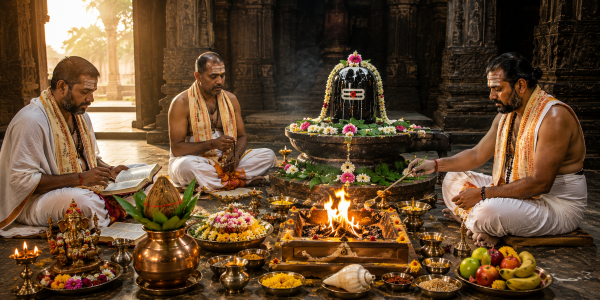
Introduction
Lord Shiva holds a special place in Hindu spirituality, particularly in the sacred city of Varanasi. Known as the city of Mahadev, Kashi attracts devotees seeking spiritual guidance, peace and divine blessings.
One of the most revered practices dedicated to Lord Shiva is Mahamrityunjaya Jaap. This sacred mantra is traditionally associated with protection, spiritual strength, courage and freedom from fear.
Devotees from different parts of India visit Varanasi to arrange Mahamrityunjaya Jaap and Anushthan under the guidance of experienced Vedic Pandits.
What Is Mahamrityunjaya Jaap?
Mahamrityunjaya Jaap involves the repeated chanting of the Mahamrityunjaya Mantra, which appears in the Rigveda.
It is also known as the Tryambakam Mantra and is dedicated to Lord Shiva in his form as Tryambaka.
The mantra is traditionally recited as a prayer for well-being, spiritual strength and liberation from the fear of death.
Mahamrityunjaya Mantra
ॐ त्र्यम्बकं यजामहे सुगन्धिं पुष्टिवर्धनम्।
उर्वारुकमिव बन्धनान्मृत्योर्मुक्षीय मामृतात्॥
Meaning:
We worship the three-eyed Lord Shiva, who nourishes and sustains all beings. May He liberate us from the bondage of death, just as a ripe fruit naturally separates from its stem, and lead us towards immortality.
Spiritual Significance of Mahamrityunjaya Jaap
The mantra holds great importance in Shaiva traditions.
Devotees perform this Jaap for several spiritual purposes:
- Seeking blessings of Lord Shiva.
- Developing courage and inner strength.
- Praying for the well-being of family members.
- Finding spiritual peace during difficult circumstances.
- Offering prayers for the health and longevity of loved ones.
- Strengthening devotion through mantra chanting.
It is a religious practice and should not be considered a substitute for medical treatment.
How Is Mahamrityunjaya Jaap Performed?
A traditional Mahamrityunjaya Anushthan may include the following steps.
1. Sankalp: The Pandit takes the devotee's name and details while establishing the purpose of the ceremony.
2. Ganesh Puja: Lord Ganesha is worshipped before the main ritual.
3. Kalash Sthapana: A sacred Kalash is established according to the prescribed procedure.
4. Shiva Puja: Lord Shiva is worshipped using flowers, Bilva leaves, water and other offerings.
5. Mantra Jaap: The Mahamrityunjaya Mantra is chanted a prescribed number of times.
6. Havan: Depending on the Anushthan, offerings are made into the sacred fire while chanting the mantra.
7. Purnahuti: The ceremony concludes with the final offering and prayers.
How Many Times Should the Mantra Be Chanted?
The number of repetitions depends on the purpose of the Anushthan and the tradition followed by the Pandit.
Some commonly followed counts include:
- 108 repetitions for a shorter devotional practice.
- 1,008 repetitions for an extended Jaap.
- 11,000 repetitions for a more elaborate Anushthan.
- 1,25,000 repetitions for a larger traditional Purascharana or Jaap arrangement.
These are examples of traditional counts, not mandatory requirements for every devotee.
Why Perform Mahamrityunjaya Jaap in Varanasi?
Varanasi is closely associated with Lord Shiva and is traditionally regarded as His sacred abode.
Performing Shiva-related religious ceremonies in Kashi holds special spiritual importance for many devotees.
Families who cannot travel to Varanasi can also enquire about arranging rituals through a local Pandit, subject to availability and the ceremony's requirements.
Book Mahamrityunjaya Jaap in Kashi
If you wish to perform Mahamrityunjaya Jaap in Varanasi, Tirth Kshetra Purohit can assist with arranging experienced Vedic Pandits and traditional puja procedures.
Contact us to discuss the Jaap count, duration, Havan requirements and preferred dates.