Navagraha Shanti Puja
- Home
- Navagraha Shanti Puja
Navagraha Shanti Puja

Introduction
In Hindu astrology, the nine Grahas or planetary influences hold an important position in understanding an individual's horoscope.
According to traditional Jyotish principles, the position of these Grahas is considered while studying different aspects of life, including education, career, relationships and personal circumstances.
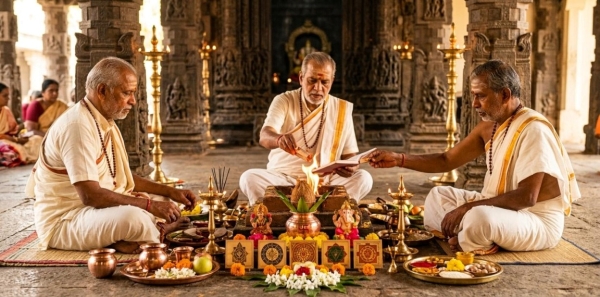
Navagraha Shanti Puja is a traditional Vedic ceremony performed to worship the nine planetary deities and seek their blessings.
Varanasi, with its strong association with Vedic traditions and religious learning, is an important destination for devotees wishing to perform this ceremony.
What Is Navagraha Shanti Puja?
Navagraha means nine Grahas. Shanti means peace or pacification.
Navagraha Shanti Puja is a religious ceremony dedicated to the worship of nine planetary deities.
The ritual may include specific mantras, offerings, Havan and prayers according to the prescribed Vedic procedure.
People generally consider this puja after consulting an astrologer or Pandit about their horoscope and family traditions.
What Are the Nine Grahas?
The nine Grahas worshipped in Hindu astrology are:
1
Surya (Sun)
Associated with authority, vitality and leadership.
2
Chandra (Moon)
Associated with emotions, mind and mental balance.
3
Mangal (Mars)
Associated with courage, energy and determination.
4
Budh (Mercury)
Associated with communication, intelligence and learning.
5
Brihaspati (Jupiter)
Associated with wisdom, knowledge and spiritual guidance.
6
Shukra (Venus)
Associated with relationships, beauty and comforts.
7
Shani (Saturn)
Associated with discipline, responsibility and karma.
8
Rahu (Ascending lunar node)
Associated with ambition, worldly desires and unconventional experiences.
9
Ketu (Descending lunar node)
Associated with detachment, spirituality and introspection.
Why Is Navagraha Shanti Puja Performed?
According to traditional Hindu beliefs, devotees perform this puja to seek blessings from the nine planetary deities.
Common reasons include:
- Seeking peace and harmony in family life.
- Praying for progress in education and career.
- Seeking blessings before starting a new venture.
- Performing traditional remedies suggested after horoscope consultation.
- Praying for stability and spiritual well-being.
- Observing religious practices during significant planetary periods.
It is important to understand that astrology-based interpretations are traditional beliefs, not scientifically established predictions.
Navagraha Shanti Puja Vidhi
The ceremony generally involves several steps.
1. Ganesh Puja
The ritual begins with prayers to Lord Ganesha.
2. Sankalp
The devotee's name and purpose of the ceremony are included in the Sankalp.
3. Navagraha Sthapana
The nine planetary deities are symbolically established for worship according to the ritual tradition.
4. Navagraha Mantra Jaap
Specific mantras are recited for the nine Grahas.
5. Offerings
Flowers, grains, fruits, incense and other prescribed materials are offered.
6. Navagraha Havan
A sacred fire ceremony may be performed with the prescribed offerings and mantras.
7. Purnahuti and Aarti
The ritual concludes with the final offering, prayers and blessings.
When Should Navagraha Shanti Puja Be Performed?
The date and muhurat depend on the purpose of the ceremony and the family's religious tradition.
A Pandit or qualified astrologer may consider:
- The person's birth details.
- The relevant planetary period.
- Tithi and nakshatra.
- The purpose of the puja.
- Traditional Vedic guidelines.
It is better to select the ceremony date after proper consultation rather than following a generic date.
Why Choose Varanasi for Navagraha Shanti Puja?
Kashi has a long association with Vedic rituals, Sanskrit learning and religious ceremonies.
Devotees visiting Varanasi often arrange special pujas to seek blessings from different deities.
Performing Navagraha Shanti Puja with proper Sankalp, mantra chanting and traditional procedures can be a meaningful religious experience for families.
Book Navagraha Shanti Puja in Varanasi
Are you planning to perform Navagraha Shanti Puja in Kashi?
Tirth Kshetra Purohit helps devotees arrange traditional Vedic pujas with experienced Pandits in Varanasi.
Contact our team to discuss your requirements, ceremony procedure and suitable dates.